
Although Shoonya was earlier popular for its zero-brokerage trading model, it has now introduced Shoonya Brokerage Charges for its many trading segments. The Finvasia-backed discount broker now charges up to ₹5 per executed order for equity intraday, futures and options (F&O), and commodity derivatives.
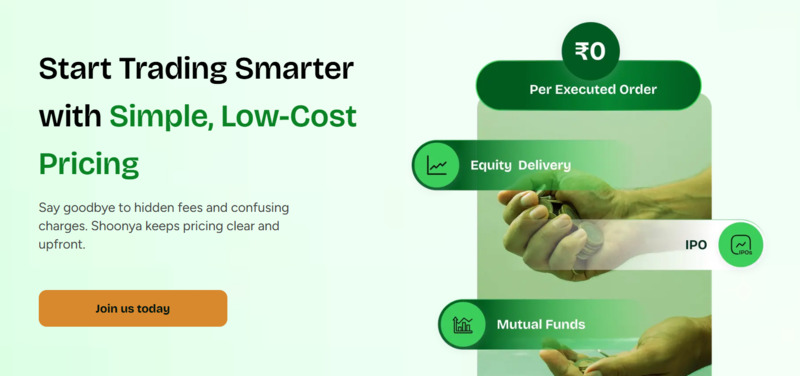
While zero brokerage is also available on equity delivery, ETFs, bonds, IPOs, and mutual funds, when placing orders here, traders must pay brokerage and other applicable charges.
Apart from brokerage, statutory levies, exchange transaction charges, GST, stamp duty, and Depository Participant (DP) charges must also be considered. To help you understand the actual costs here, we’ll break down Shoonya brokerage charges and other fees available here.
Shoonya Brokerage Charges: Latest Pricing Structure
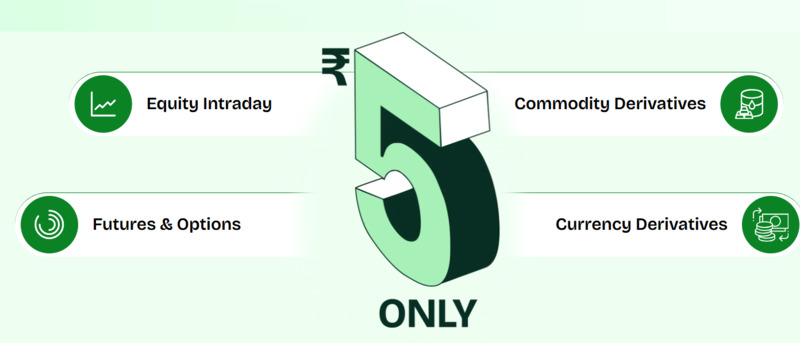
It follows a flat-fee and percentage-based brokerage model as per your trading segment. Its intraday & futures brokerage is calculated at 0.03% of the transaction value or ₹5, whichever is lower. A flat ₹5 brokerage is charged per executed order on Options trades.
| Trading Segment | Brokerage Charges |
| Equity Delivery | ₹0 |
| Equity Intraday | 0.03% or ₹5, whichever is lower |
| Equity Futures | 0.03% or ₹5, whichever is lower |
| Equity Options | ₹5 per executed order + GST |
| Currency Futures | 0.03% or ₹5, whichever is lower |
| Currency Options | ₹5 per executed order + GST |
| Commodity Futures | 0.03% or ₹5, whichever is lower |
| Commodity Options | As per applicable options pricing |
They, meanwhile, apply per executed order instead of per share. Suppose an intraday order has a transaction value of ₹10,000. In that case, 0.03% of the value comes to ₹3. ₹3 will therefore be charged instead of ₹5.
Similarly, if the transaction value is ₹30,000, then the calculated brokerage will be ₹9. As ₹5 per executed order is the maximum order limit on Shoonya, traders will only pay ₹5.
Shoonya Account Opening Charges and AMC
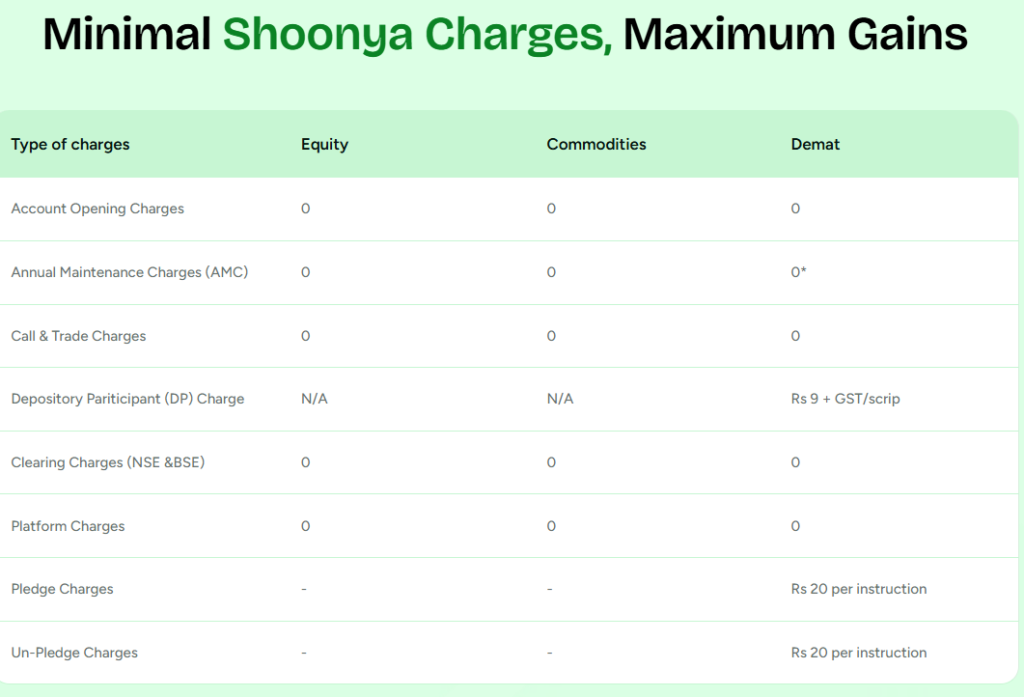
For opening an demat account here, no account opening fee. Zero platform charges, call and trade charges, and clearing charges are there. The actual Annual Maintenance Charge (AMC) depends on your account type.
Although ₹0 AMC is still available on individual trading and demat accounts, an annual maintenance fee of ₹900 is there on Corporate, Trust, and LLP accounts
| Account Charges | Applicable Fee |
| Account Opening | ₹0 |
| Individual Account AMC | ₹0 |
| Corporate, Trust and LLP AMC | ₹900 + GST |
| Call and Trade | ₹0 |
| Platform Charges | ₹0 |
| Clearing Charges | ₹0 |
| Pledge Charges | ₹20 per instruction |
| Unpledge Charges | ₹20 per instruction |
| DP Charges | ₹9 with GST per scrip |
For individual investors, there are no account opening fees. Before opening an account, potential corporate and LLP account holders should check the applicable AMC.
Why Did Shoonya Stop Offering Completely Free Trading?
On November 18, 2024, Shoonya announced that it would discontinue its zero-brokerage model. After considerable criticism on social media, the revised charges came into effect on December 2, 2024.
For active traders, ₹499 plus GST is an annual maintenance fee. ₹5 per order Shoonya Brokerage Charges are also there for intraday, F&O, and commodity derivatives. A monthly API trading fee of ₹1999 was also announced at that time.
However, Shoonya has again listed its AMC charges at ₹0 for individual accounts, and for corporate, trust, and LLP accounts, it is ₹900. Therefore, you should first visit the official Shoonya website before starting trading here.
To make sustainable revenue, the charges also came amid increasing pressure on discount brokers.
Shoonya Intraday Brokerage Charges Explained
For intraday trading, ₹5 or 0.03% of the transaction value (whichever is lower) is the Shoonya charge.
Consider an intraday trade with a buy value of ₹20,000 and a sell value of ₹20,000. So, the brokerage calculation will be:
- Buy order value: ₹20,000
- Sell order value: ₹20,000
- Brokerage on each order: ₹5
- Total brokerage: ₹10
Besides brokerage, STT, exchange transaction charges, SEBI fees, GST, stamp duty, and other applicable levies will also need to be paid. Therefore, the exact trading cost will be higher compared to the brokerage amount.
Shoonya Options Trading Charges
Irrespective of the premium or transaction value, a flat brokerage of ₹5 per executed options order is also charged.
If a trader buys an option contract and sells it later, then brokerage would be applied to both executed orders.
| Particulars | Charges |
| Options Buy Order | ₹5 |
| Options Sell Order | ₹5 |
| Total Brokerage | ₹10 |
| GST | 18% on applicable brokerage and other specified charges |
For option trading, STT is also applicable. From April 1, 2026, 0.15% STT is applicable on the sell-side options premium.
The total trading expense is also influenced by the exchange transaction charges and stamp duty. Traders should also calculate the total cost using the buy-side and sell-side transactions.
Shoonya DP Charges Explained
When shares are sold from the demat account, DP charges are applicable. They are separate from the Shoonya Brokerage Charges. These charges are also collected for depository-related services.
DP charges of ₹9 plus GST per scrip is there on Shoonya.
If an investor sells shares of 2 different companies from their demat account, then the DP charge applies separately to both scrips.
These charges are not applicable to each intraday transaction that happens here because they are squared off. When calculating your overall investment costs, investors who plan to hold shares for the long term should add DP charges to it.
Government Taxes and Other Regulatory Charges
Even after zero Shoonya Brokerage Charges, several government and exchange-related charges are there in the stock markets. Shoonya collects these charges as per the transaction and trading segment. Here is the breakdown of its top charges:
1. Securities Transaction Tax (STT)
It is a government tax applicable to eligible securities transactions. As per the Shoonya pricing schedule, the revised rates are:
| Trading Segment | STT Rate |
| Equity Intraday | 0.025% on sell side |
| Equity Delivery | 0.1% on buy and sell |
| Equity Futures | 0.05% on sell side |
| Equity Options | 0.15% on sell-side premium |
| Commodity Futures and Options | No STT under the listed schedule |
2. Exchange Transaction Charges
Through their platforms, stock exchanges collect transaction charges for trades executed here. The exchange and trading segment plays an important role here. The following are the revised rates:
| Trading Segment | Transaction Charges |
| NSE Equity Intraday | 0.00307% |
| NSE Equity Delivery | 0.00307% |
| NSE Futures | 0.00183% |
| NSE Options | 0.03553% on premium |
| Currency Futures | 0.00035% |
| Currency Options | 0.0311% |
These charges are based on the applicable transaction value or options premium.
3. SEBI Charges
SEBI charges of ₹10 per crore of transaction value are also applicable across the listed equity, derivatives, and currency segments. Despite being relatively small, they are part of the total cost.
4. GST
18% GST is also charged on the applicable brokerage, SEBI charges, and exchange transaction charges. Suppose ₹10 is the combined applicable charges. In that case, ₹1.80 will be the GST applicable on those charges.
5. Stamp Duty
As rates vary by segment, stamp duty is collected on the buy-side transaction.
| Segment | Stamp Duty |
| Equity Delivery | 0.015% |
| Equity Intraday | 0.003% |
| Futures | 0.002% |
| Options | 0.003% |
| Currency Futures | 0.0001% |
| Currency Options | 0.0001% |
| MCX Futures | 0.002% |
| MCX Options | 0.003% |
Is Shoonya Still a Zero-Brokerage Trading Platform?
For now, Shoonya is not a completely free platform.
However, it offers zero brokerage on these investment products:
- Equity delivery trades
- Exchange-traded funds (ETFs)
- Bonds
- Initial Public Offerings (IPOs)
- Mutual funds
Without brokerage, investors here can buy and hold eligible delivery shares. However, on sales, statutory charges and DP charges may still apply. For intraday, futures, and options traders, the ₹5 per-order brokerage means that trading is not entirely free.
For investors who purchase and hold shares, the platform offers some cost advantages. However, instead of focusing on brokerage, active traders should compare the complete fee structure.
Read more: Lemon Trading App Review (Lemonn): Lemon Brokerage Charges
Best stock recommendations app (My Favorite)
Shoonya Back Office: How to Login and Use it?
FAQs
1. Is Shoonya still a free trading platform?
No, as of December 2. 2024, Shoonya has discontinued its completely zero-brokerage model. Now, it charges brokerage on intraday, futures, options, and commodity derivatives transactions. However, brokerage charges are still there on eligible equity delivery, ETF, bond, IPO, and mutual fund transactions
2. What is the brokerage charge of Shoonya per order?
For equity intraday and futures orders, Shoonya charges 0.03% or ₹5 (whichever is lower). A flat ₹5 + GST brokerage per executed order is charged on option trading.
3. Does Shoonya charge AMC?
As per the current published charges, zero AMC is applicable on individual accounts. For corporate, Trust, and LLP accounts, an annual maintenance fee of ₹900 plus GST is applicable.
4. What are Shoonya DP charges?
As a Depository Participant (DP) charge, Shoonya charges ₹9 plus GST per scrip. When shares are sold from a demat account, these charges are generally applied.
5. Does Shoonya charge brokerage on delivery trades?
No, zero brokerage are there on eligible equity delivery trades. However, investors must still pay applicable STT, exchange transaction charges, GST, stamp duty, etc.
Conclusion
Shoonya Brokerage Charges have wiped out Shoonya’s biggest reasons for its popularity. Across several trading segments, brokerage charges of up to ₹ 5 per executed order have been introduced.
However, for long-term investors, zero brokerage is still available on eligible equity delivery, ETFs, bonds, IPOs, and mutual funds. Before opening an account here, you should check the latest brokerage schedule.